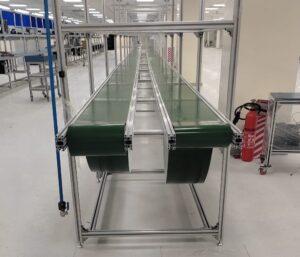
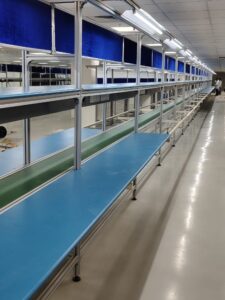
The belt conveyor uses a motor-driven belt to move products from one point to another.
Product Loading: Small components are placed on the conveyor belt.
Belt Movement: The drive motor moves the belt at the selected operating speed.
Product Transportation: Components travel along the conveyor to the next workstation.
Assembly Operation: Operators or automated equipment perform the required assembly, inspection or testing process.
Product Transfer: Finished or partially assembled products move to the next production stage.
The conveyor speed and layout can be selected to suit the required production workflow.
Products That Can Be Handled
The conveyor can be designed for suitable products such as:
- Small plastic components
- Electronic parts and housings
- Electrical components
- Appliance fittings
- Small metal parts
- Molded plastic products
- Assembled subcomponents
- Small packaged products
- Inspection and testing samples
- Light-duty industrial components
Product size, weight, surface and stability should be evaluated before selecting the belt type.
Customization Options
The Belt Conveyor for Small Assembly can be customized according to the production requirement.
- Custom conveyor length and width
- Fixed or adjustable conveyor heightVariable-speed motor
- Different belt materials
- Side guides and product stoppers
- Workstation support structures
- Collection trays
- Sensors and product detection
- Start/stop controls
- Integration with inspection or testing equipment
- Integration with other conveyors and assembly-line equipment
Why Choose WIPL Industries?
WIPL Industries provides industrial material handling and production automation solutions designed around customer-specific manufacturing requirements.
A Belt Conveyor for Small Assembly can be configured according to product dimensions, material flow, workstation arrangement and production objectives. The system can also be planned for integration with existing assembly lines and other material handling equipment.
Contact WIPL Industries to discuss your conveyor dimensions, product weight, required speed and assembly-line layout.
Note: Final conveyor dimensions, belt material, motor power, speed range and load capacity should be confirmed according to the actual machine design and customer requirements.
Contact Us